
Quick Answer
Trenchless sewer repair in Universal City uses one of two methods: pipe lining (CIPP) inserts a resin-saturated liner into the existing pipe and cures it into a new pipe wall, or pipe bursting pulls a new HDPE pipe through the old one while fragmenting the old pipe outward. Both methods avoid trenching across hillside lots. Pipe lining is right when the existing pipe is structurally sound. Pipe bursting is right when the existing pipe is collapsed, severely damaged, or undersized.
If you own a Universal City home that needs sewer line repair, the difference between trenchless work and traditional excavation can be tens of thousands of dollars. On hillside lots with narrow access, mature landscaping, and hardscape that would be brutal to restore, trenchless is almost always the right answer. The question becomes which trenchless method.
This is the practical decision guide.
Why Universal City Is Trenchless Territory
Universal City and the surrounding hillside neighborhoods present three conditions that make traditional sewer excavation painful:
Narrow access. Steep driveways and tight street access often prevent full-size excavation trucks from reaching the work area.
Mature landscaping and hardscape. Restoring 60 feet of trenched yard plus retaining walls, walkways, and irrigation can cost more than the actual plumbing work.
Sloped terrain. Trenching across a hillside creates structural and drainage concerns that trenchless work avoids.
We covered the broader hillside plumbing challenges in our Universal City hillside plumber post. For sewer work specifically, trenchless methods solve the access and restoration problems in one move.
For background on trenchless technology overall, the EPA’s pipe rehabilitation technologies guide is the standard reference.
Pipe Lining (CIPP): The Less Invasive Option
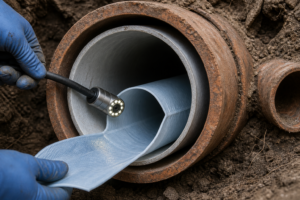
Cured-in-place pipe lining, usually called CIPP or just pipe lining, works like this:
A flexible liner saturated with resin is inserted into the existing sewer line through a cleanout.
The liner is inflated against the inside of the existing pipe.
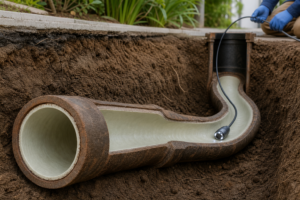
Heat or UV light cures the resin, hardening the liner into a new pipe wall inside the old one.
The result is a seamless new pipe inside the old one, sealing all joints, eliminating root entry points, and restoring full flow capacity.
When pipe lining is the right call:
The existing pipe is structurally sound (not collapsed, not severely bellied).
Root intrusion is the main issue.
Joint failures are causing repeat backups.
The pipe diameter is adequate for current needs.
You want minimal disruption to the yard.
When pipe lining is NOT the right call:
The pipe has collapsed sections.
The pipe is undersized for the home’s needs.
Major bellies are causing waste to pool.
The pipe material is so deteriorated it cannot support liner inflation.
For Universal City homes considering this option, our pipe lining service for Universal City covers the full process from camera inspection to final test.
We also explained the broader case in our trenchless pipeline rehabilitation post, which is worth reading for the technical details.
Pipe Bursting: The Full Replacement Option
Pipe bursting replaces the existing pipe entirely without trenching. The process:
Two small access pits are dug, one at each end of the section being replaced.
A bursting head is pulled through the existing pipe from one pit to the other.
As the head moves through, it fragments the old pipe outward into the surrounding soil.
A new HDPE pipe is pulled in behind the bursting head, taking the path of the old pipe.
The result is a brand new pipe in the same location, with no trenching in between the access pits.
When pipe bursting is the right call:
The existing pipe is collapsed or severely damaged.
The pipe is undersized and you want to upgrade to a larger diameter.
The pipe material has failed beyond what lining can rehabilitate.
You want a complete replacement, not a rehabilitation.
When pipe bursting is NOT the right call:
The existing pipe is in close proximity to other utilities that the bursting force could damage.
The pipe has unusual bends or fittings that bursting cannot navigate.
Soil conditions cannot tolerate displacement (rare, but a factor in some specific Universal City hillside areas).
Our pipe bursting service for Universal City handles the full process including camera verification and city permits. The broader technical explanation lives in our pipe bursting trenchless technology page.
The Decision Sequence
You do not decide between lining and bursting on instinct. The decision is data-driven:
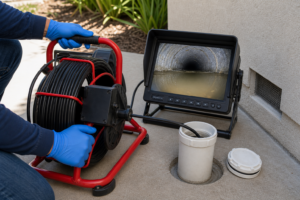
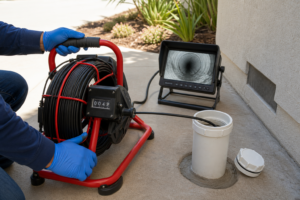
Step 1: Camera inspection. A Universal City sewer camera inspection shows you exactly what is in the line and what condition the pipe is in. This is the single most important step. Without footage, you are guessing.
Step 2: Structural assessment. Based on the camera footage, the plumber assesses whether the pipe can hold a liner under inflation pressure. Borderline cases sometimes get a stronger fiberglass liner, sometimes get rejected for lining.
Step 3: Sizing check. If the existing pipe is too small for the home’s current usage (common with older 4-inch lines serving homes that have been expanded), bursting and upsizing may be required.
Step 4: Cost comparison. With access constraints and material costs factored in, get itemized estimates for both methods. On most Universal City hillside lots, the difference is meaningful enough to drive the decision.
We covered the cost side broadly in our sewer line replacement Los Angeles cost guide, which provides realistic ranges for both approaches.
What About Traditional Excavation?
In some Universal City situations, full excavation is still required. Examples:
Connecting a new sewer line to a relocated city tap.
Replacing a section where access pits cannot be safely dug at both ends.
Repairing a collapse that has caused soil displacement around the pipe.
When excavation is the only option, our sewer line repair and replacement page covers that scope. But for most hillside Universal City sewer projects, trenchless methods get the job done with a fraction of the disruption.
Permits and Inspections
Universal City sewer work falls under City of Los Angeles permit requirements. A licensed plumber pulls the permit, manages the inspection, and provides the closed documentation. The LA Bureau of Sanitation handles sewer-related approvals. Skipping the permit creates a future problem at resale.
The Quick Decision Matrix
If the existing pipe is structurally sound but full of roots, scale, and joint failures: pipe lining.
If the existing pipe is collapsed, undersized, or beyond rehabilitation: pipe bursting.
If access pits cannot be dug at both ends or the line crosses critical utilities: traditional excavation.
A real Universal City sewer specialist gives you camera footage, an itemized comparison, and an honest recommendation based on what the data shows. Anyone pitching a method before they have seen the inside of your line is guessing.
For a starting point on any of these decisions, our Universal City plumbing service page is the right place to begin, and our trenchless specialists can be on-site to camera-inspect quickly.