



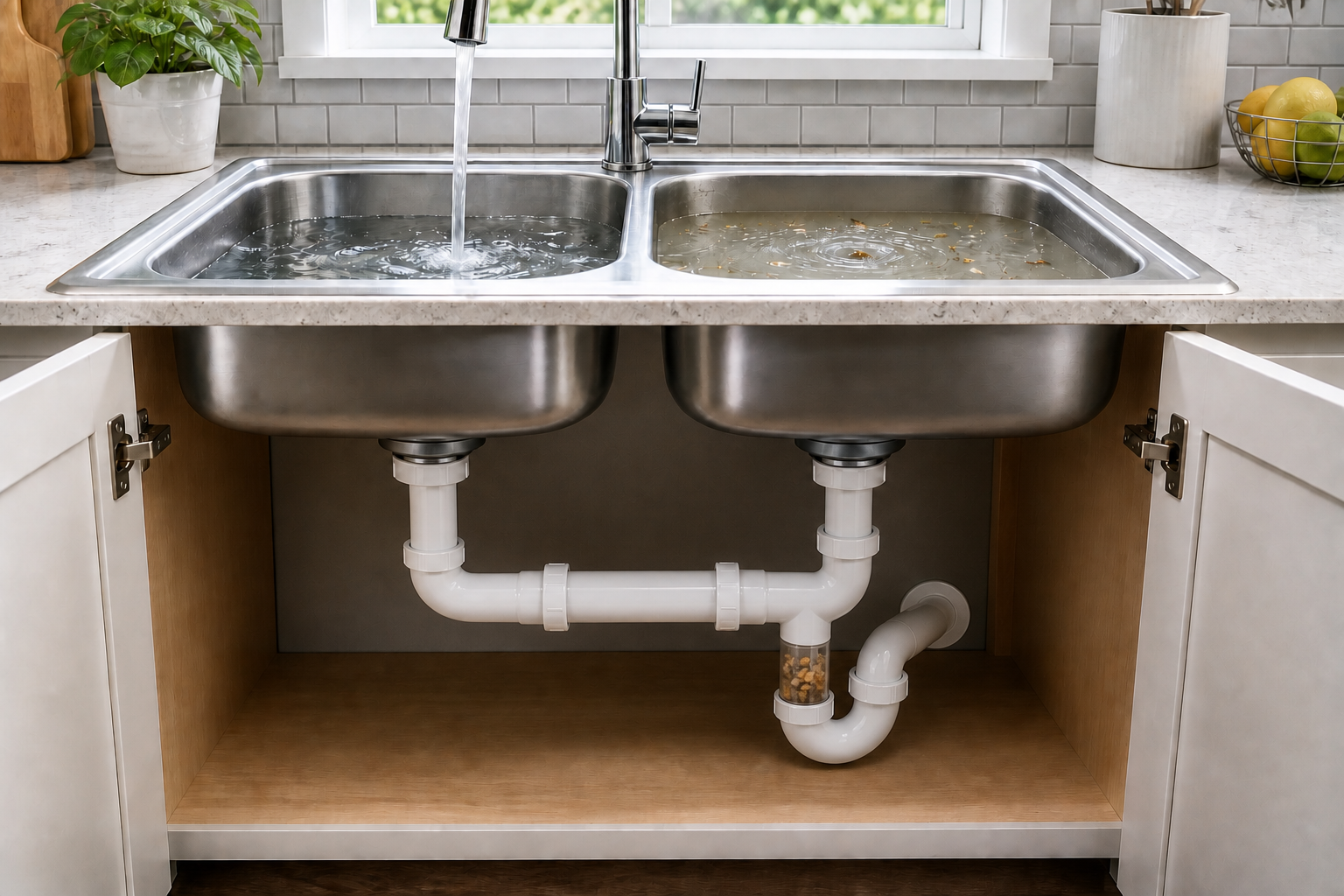
One side of a double kitchen sink usually backs up into the other because both bowls join the same drain path. When a restriction forms after that connection, water from one bowl cannot move freely toward the wall. The shared piping gives it another place to go, so it rises through the other bowl’s drain.
The symptom often points to a clog in the shared trap or kitchen branch, but it does not identify the exact location or material by itself. Grease, food residue, soap film, and other buildup are common possibilities. A plumber still needs to consider how quickly the water moves between bowls, whether both sides drain slowly, what happens when other fixtures run, and whether the problem returns after the sink empties.
How Two Sink Bowls Share One Drain
A double-basin sink has two drain openings, but the piping below usually combines them before wastewater enters the wall. Each bowl may have its own tailpiece. One side may also connect to a garbage disposal, and a dishwasher hose may discharge into the disposal or another approved fitting. The exact arrangement varies.
Downstream, the two sides normally share a trap and kitchen branch. The trap holds a small amount of water to block sewer gas. The branch carries sink water away from the cabinet and toward the larger drainage system.
When that shared route is clear, water from either bowl moves past the junction and through the trap. When the route is restricted, the incoming water can fill the common piping faster than it drains. Once the water reaches the level of the other basin’s connection, it rises there.
That is why a sink can appear to move water sideways. It is not traveling from bowl to bowl across the countertop. It is moving down one drain, meeting resistance in the shared pipe, and returning through the other drain opening.
Does the Backup Reveal Where the Clog Is?
It narrows the possibilities, but it does not provide an exact location. Cross-basin backup usually means the restriction is downstream of the point where both bowls connect. If the clog were confined above that junction on only one side, water entering the other bowl could still have a clear route out.
The restriction may be close to the trap, farther into the kitchen branch, or at another point that affects the shared line. The water level and timing provide useful clues:
- Water rises in the other bowl almost immediately when the faucet runs.
- Both bowls drain slowly after the faucet is turned off.
- The water level drops only after several minutes.
- Dirty water or residue returns even when the receiving bowl was not used.
- The problem clears temporarily and then returns.
- Running a nearby fixture changes the water level in the sink.
These observations help determine the next test. They do not prove that the clog is grease, that it sits inside the trap, or that the branch is damaged.
What If the Garbage Disposal Triggers the Backup?
Running a garbage disposal can push water through the shared drain faster than a restricted pipe can accept it. That extra flow may make water surge into the other bowl. The timing does not automatically mean the disposal caused the clog or needs replacement.
If water is already standing in either basin, stop using the disposal. A spinning disposal can splash dirty water and debris through the open drain on the other side. It also will not correct a restriction farther downstream.
Listen for unusual sounds only from a safe distance and report them when requesting service. Do not put a hand or tool into the disposal opening, even when the switch is off. A disposal problem and a shared-drain clog can happen at the same time, so both conditions may need to be checked separately.
Can the Dishwasher Make Water Rise in the Sink?
Yes. A dishwasher discharge can reveal the same restricted drain path. The dishwasher sends a concentrated volume of water into its connection. If the shared trap or kitchen branch cannot carry that flow away, water may appear in one or both sink bowls.
That does not prove the dishwasher is defective. Note when the backup occurs: at the start of a cycle, during a drain phase, only after the sink was already slow, or every time the dishwasher empties. Also note whether the water contains food residue or has an odor.
Stop the dishwasher if it is actively adding water to a sink that is close to overflowing. Avoid running more fixtures simply to see whether the problem repeats. The additional water can turn a contained backup into cabinet or floor damage.
Is This a Local Kitchen Clog or a Deeper Drain Problem?
A problem limited to the double sink is more consistent with a local trap or kitchen-branch restriction. A broader pattern changes the concern.
Tell the plumber if any of these are also happening:
- A nearby floor drain, laundry drain, tub, or shower is slow.
- A toilet gurgles when the kitchen sink drains.
- Water appears at another low fixture.
- Several fixtures back up at the same time.
- The sink problem returns soon after prior drain clearing.
- Sewer odor or wastewater appears outside the kitchen sink.
Multiple affected fixtures can point to a restriction beyond the immediate sink connection. The lowest affected drain and the order in which symptoms appear may help identify which branch is involved.
If the symptoms extend beyond the kitchen, a sewer camera inspection may be discussed after access and flow conditions are evaluated. A camera is not automatically necessary for every double-sink clog, and it cannot see through every blocked or dirty section.
What Should You Do While the Sink Is Backed Up?
Stop adding water to both bowls. Turn off the faucet, pause the dishwasher if it is discharging, and leave the disposal off. Move items away from the wet area and place towels where they can contain splashes without reaching an electrical connection.
Do not add chemical drain cleaner. If another product is already in the sink, tell the plumber before work begins. Mixing products can create heat, fumes, or splashing hazards, and chemicals left in standing water can expose anyone who opens the piping.
Avoid taking apart a full trap while both bowls hold water. The combined contents can release quickly into the cabinet, and the water may contain chemicals or contaminated residue. Do not insert a powered cable or improvised tool into the drain.
If the water level is stable and well below the rim, leave it undisturbed until the service plan is clear. If it is rising, stop every known source feeding the sink and keep people away from the wet cabinet and nearby electrical items.
How Does a Plumber Narrow Down the Restriction?
The first step is to understand the layout and symptom pattern. A plumber may check whether both bowls connect before the trap, whether a disposal or dishwasher is involved, how the trap and wall connection are arranged, and whether there is a suitable access point.
The drainage pattern matters as much as the visible piping. Useful checks may include:
- Observing which bowl receives water first.
- Comparing the response to a small, controlled flow from each side.
- Checking whether the trap or accessible connection contains a local obstruction.
- Determining whether the restriction continues into the wall branch.
- Asking which other fixtures are slow or noisy.
- Reviewing what drain products or prior clearing attempts were used.
- Confirming whether the problem is recurring or new.
The appropriate cleaning method depends on the location, access, pipe condition, and material causing the restriction. A local obstruction near the sink may require a different approach from heavy buildup farther along the branch.
When Is Professional Drain Cleaning Appropriate?
Arrange drain cleaning in Los Angeles when the bowls will not drain, water repeatedly transfers from one side to the other, the backup returns after a temporary improvement, or the symptom involves more than one fixture.
Professional service is also appropriate when chemical cleaner is present, the under-sink piping is leaking, disposal use repeatedly triggers the backup, or opening the trap would release a large volume of dirty water. Share those details before work starts so the drain can be approached safely.
For recurring heavy buildup in a suitable line, hydro jetting may be discussed after the pipe route and condition are considered. It is not the automatic answer for every kitchen clog. Access, pipe material, the suspected restriction, and whether another diagnostic step is needed all affect the decision.
What Should You Tell the Plumber?
Describe the sequence rather than simply saying the sink is clogged:
- Which bowl receives water and which bowl backs up.
- Whether the backup starts with the faucet, disposal, or dishwasher.
- How quickly water rises in the other bowl.
- How long both bowls take to drain.
- Whether dirty water, food residue, or odor returns.
- Whether any other fixture is slow, noisy, or backing up.
- Whether the problem happened before.
- Whether a drain product or prior cleaning attempt was used.
- Whether the cabinet, trap, or wall connection is leaking.
Those details help distinguish a shared sink restriction from a deeper kitchen branch or larger drainage problem before the cleaning scope is chosen.
Arrange Drain Cleaning in Los Angeles
If water from one side of your double kitchen sink rises into the other, stop adding water and arrange a drain evaluation. The cross-basin movement shows that the shared path is not carrying flow normally, even though the exact restriction still needs to be located.
Contact Coast to Coast Plumbing and Rooter at (310) 275-5800. Describe the backup sequence, disposal or dishwasher use, other affected fixtures and any drain products already used so the team can discuss an appropriate assessment.