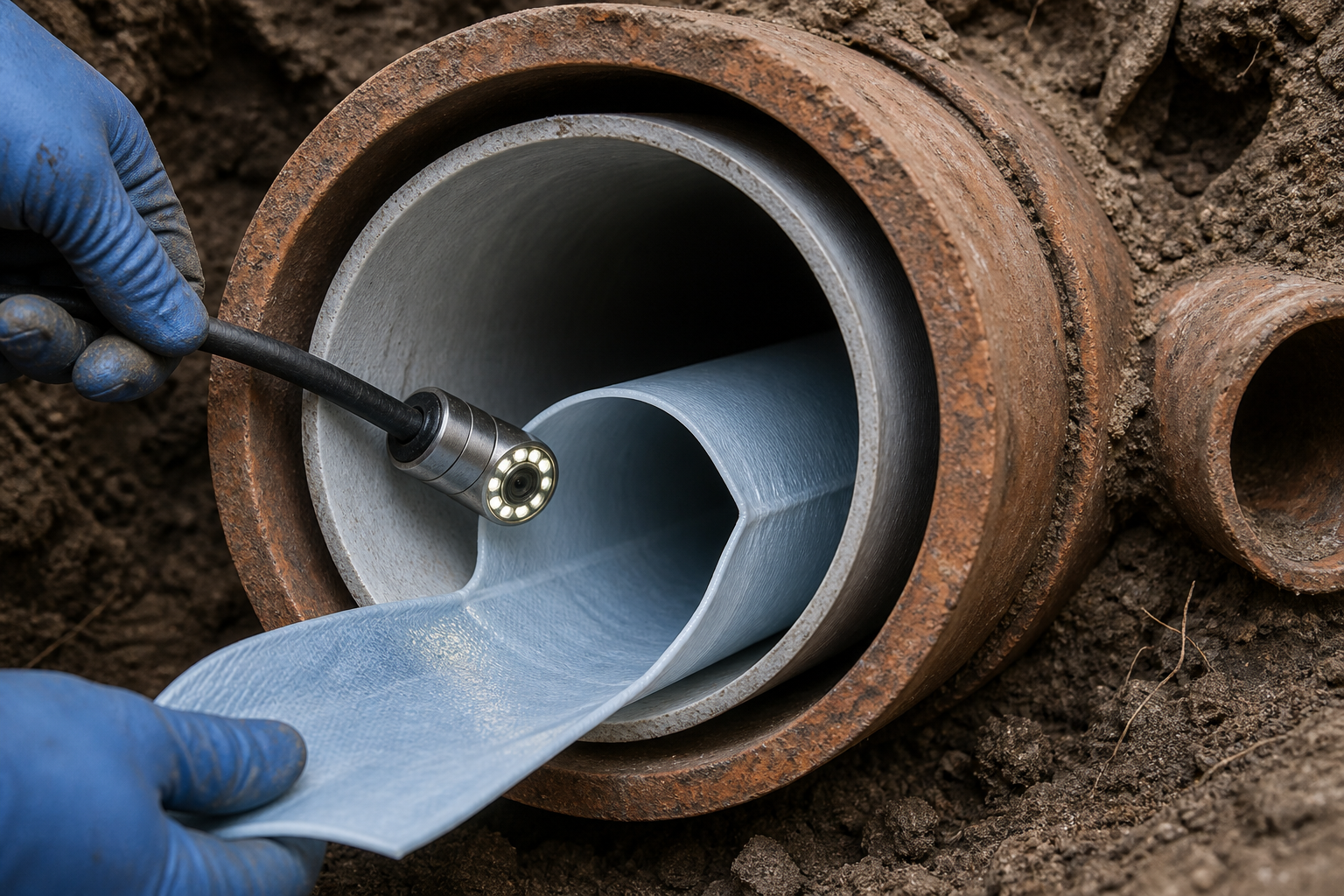



Sometimes a sewer line that already contains a cured-in-place liner can be lined again, but the old liner does not automatically make a second lining possible or impossible. The decision depends on what failed, how much open diameter remains, whether the existing liner is stable, and whether a new liner can be installed and cured without creating another problem.
Recurring backups or new damage are reasons to inspect the line, not reasons to choose a second liner immediately. A plumber should clean the accessible section as appropriate, record current camera footage, locate the defect, review any records from the first installation, and compare a second liner with localized repair, pipe bursting, or excavation.
The Existing Liner Becomes Part of the New Repair Condition
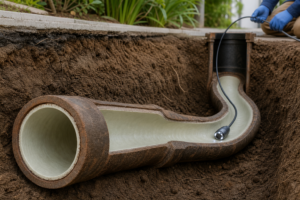
During trenchless pipe lining, a resin-saturated tube is installed and cured inside an existing pipe. Once that first liner is in place, a later contractor is no longer evaluating only the original clay, cast iron, concrete, or other host pipe. The contractor must also evaluate the liner now forming the sewer’s interior.
That liner may be smooth and stable along most of the route while having a problem in one location. It may also show wrinkles, a separated area, a damaged opening at a branch connection, a poorly finished end, or a section whose shape has changed. The location and extent of the condition matter because a short, accessible defect may call for a different response than a problem running through most of the lined section.
A second liner would follow the opening that exists now. It cannot be evaluated from the original pipe size or an old proposal alone.
Start With a Documented Sewer Camera Inspection
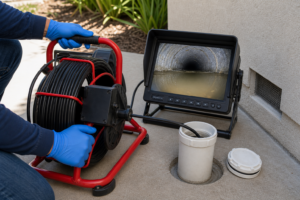
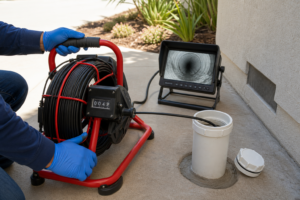
A current sewer camera inspection should show the already-lined section from a known access point. The plumber should identify the beginning and end of the prior liner, record distance readings as location estimates, and document each questionable area from more than one camera position when access allows.
Useful findings include:
- Whether the camera can travel through the full lined section.
- The visible shape and continuity of the existing liner.
- Wrinkles, folds, holes, cracks, separated areas, or exposed host pipe.
- Standing water or deformation that may hide part of the interior.
- The location and condition of branch connections.
- Root, grease, scale, or debris that must be removed before a reliable decision.
- The smallest usable opening along the proposed repair route.
A camera image alone may not reveal every condition behind the existing liner. That limitation should be stated rather than replaced with an assumption about the hidden host pipe.
Remaining Diameter and Connections Must Still Work
Every liner occupies some space inside the current opening. Adding another layer can reduce the inside diameter again, especially where the first liner already has a fold, offset, tight bend, or narrowed section. The relevant measurement is the usable opening after the first installation, not simply the nominal diameter of the original sewer.
The plumber also needs to account for every connection entering the lined section. A second liner may cover branch openings during installation, and those openings must be located and restored using a method appropriate to the system. A connection that was already cut irregularly or left partly obstructed deserves specific review before another layer is added.
Ask how the contractor confirmed the current diameter and connections and how the proposed repair would affect flow. A general statement that lining is thin is not a substitute for measurements from the actual line.
A Second Full-Length Liner May Be Considered in Some Conditions
A second liner may be considered when the existing route remains open and accessible, the defect is understood, cleaning and preparation can produce a suitable interior, the remaining diameter supports another layer, and the installer has a job-specific design and curing procedure.
Industry technical guidance recognizes that repairing a cured-in-place-pipe defect can sometimes involve installing new CIPP inside existing CIPP. It also warns that the existing liner can insulate the new liner during curing and change how heat moves through the pipe. That means a contractor should not simply repeat the first installation settings. The resin system, liner design, cure method, temperatures, timing, and quality-control steps must fit the current pipe-within-a-pipe condition.
Homeowners do not need to design that process, but they can ask for a clear explanation of how the installer accounted for the existing liner and how the completed work will be inspected.
A Localized Repair May Fit a Localized Defect
If the problem is limited to a short, well-defined area, a sectional repair may be evaluated instead of covering the entire lined route again. The defect’s location, length, access, surrounding liner condition, and nearby branch connections all affect whether a local repair is practical.
A patch should not be selected merely because it sounds less disruptive. The repair must extend over suitable material on both sides of the defect and preserve the usable opening. Conversely, a full second liner should not be selected merely because one small location is damaged. The repair length should follow the documented condition.
Request before-and-after footage that identifies the repaired limits. If the contractor cannot show where the defect begins and ends, there is not enough information to compare a sectional repair with a longer one.
Pipe Bursting or Excavation May Be the Better Direction
Another liner may not be appropriate when the route is collapsed, severely deformed, inaccessible, too narrow, or affected by a connection or grade problem that lining cannot correct. A failed host-pipe condition hidden behind the liner may also require more investigation before a new layer is considered.
pipe bursting replaces the existing route by pulling new pipe through it, but eligibility still depends on access, connections, surrounding utilities, and the condition of the route. Targeted excavation can provide direct access when a collapse, connection, transition, or isolated structural problem cannot be handled reliably from inside the pipe.
These options should be compared through a sewer line repair and replacement plan tied to the inspection findings. The presence of an old liner by itself does not prove that excavation is necessary, just as it does not prove that another trenchless repair will work.
Gather Records From the First Lining Job
Prior installation records can reduce uncertainty. Ask the former installer, property seller, building manager, or previous owner for any available:
- Pre-installation and post-installation camera footage.
- Proposal or diagram showing the lined limits and access points.
- Original pipe and liner dimensions.
- Liner material, resin, cure method, and installation date.
- Branch-connection locations and reinstatement records.
- Quality-control or acceptance records.
- Warranty terms and prior repair history.
Missing records do not automatically rule out repair, but they make a fresh inspection and measurement even more important. Do not rely on a statement that the line was “sleeved” without confirming what material was installed, where it begins and ends, and which section now has the problem.
Questions to Ask Before Approving Another Liner
Before choosing a second lining job, ask the contractor:
- What exact defect is visible, and where is it located?
- Is the problem in the existing liner, the hidden host pipe, a connection, or more than one of these?
- What is the smallest measured opening through the proposed repair route?
- Can the line be cleaned and prepared without damaging the current liner?
- Would a sectional repair address the documented condition?
- How would another liner affect branch openings and usable diameter?
- What curing changes are required because a liner is already present?
- Why is a second liner preferable to pipe bursting or targeted excavation here?
- What pre-work and post-work footage, measurements, and test records will be provided?
A useful recommendation should connect each part of the proposed repair to a visible finding or a documented limitation. If the inspection is incomplete, the next step is to resolve that gap rather than commit to a method.
Choose the Repair After Inspecting the Existing Liner
A previously lined sewer may still have a trenchless repair option, including a second liner in some circumstances. The safe answer comes from the present condition of the old liner, the remaining opening, the branch connections, the host-pipe limitations, access, and a cure plan designed for the actual system.
If a lined sewer at your Los Angeles property has new symptoms or visible damage, contact Coast to Coast Plumbing and Rooter. The team can inspect the existing liner, document the affected section, and explain whether another liner, a localized repair, pipe bursting, or excavation best matches the findings.