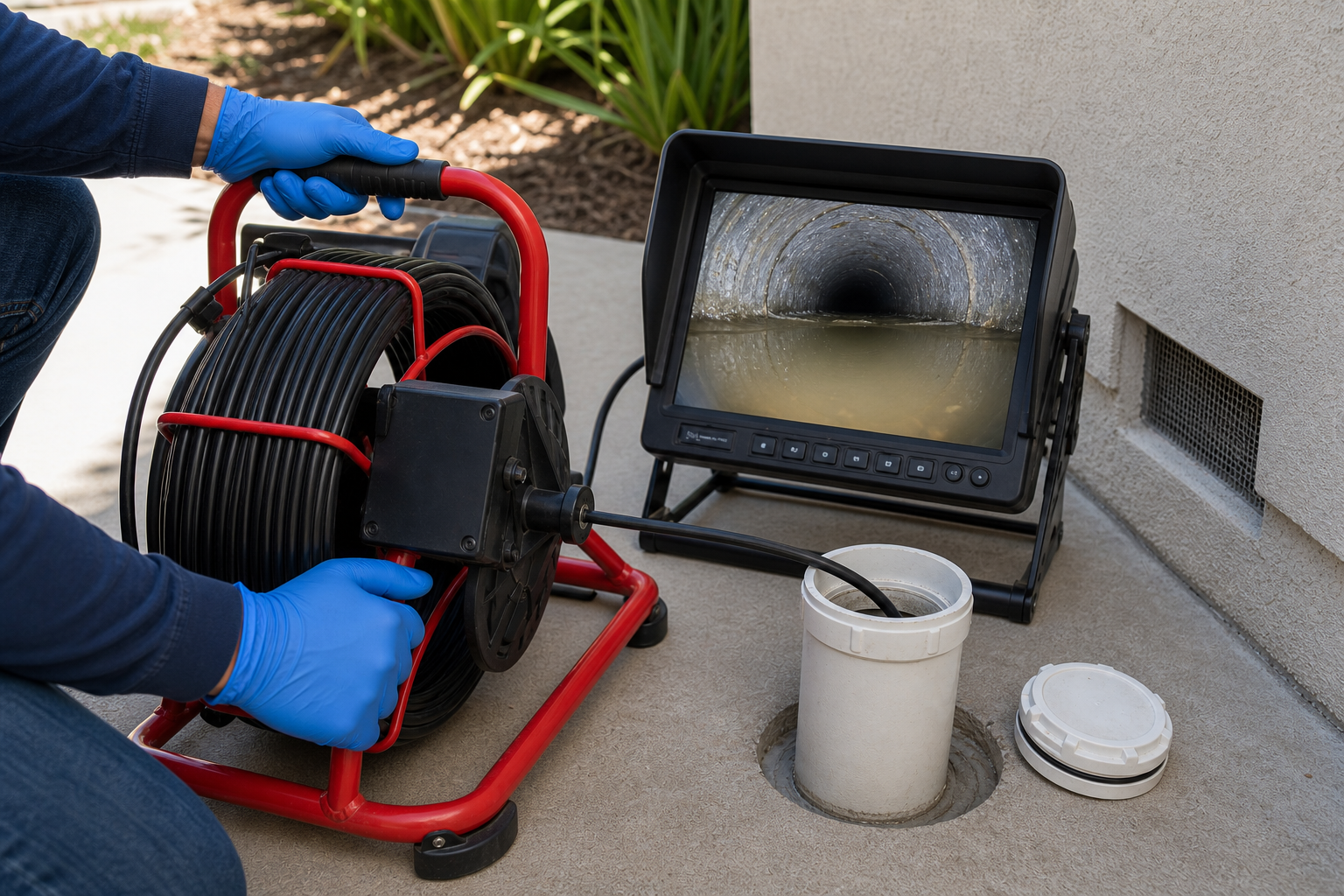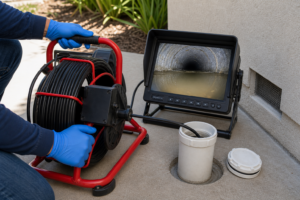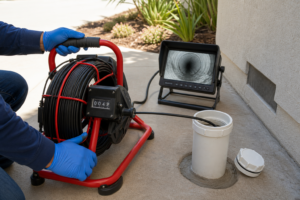



A sewer camera goes underwater when liquid inside the pipe becomes deep enough to cover part or all of the lens. The footage confirms that water or wastewater occupied that section during the inspection, but the image alone does not explain why it was there.
A low section of pipe is one possibility. So are active wastewater flow, slow drainage behind a restriction, retained water near a fitting, or a lens coated with residue. The plumber needs to consider where the camera entered, how the water changed as the camera moved, what the pipe looked like before and after the submerged area, and whether a repeat pass showed the same condition.
What an Underwater Camera View Actually Shows
The most reliable observation is simple: the lens encountered liquid. A distinct horizontal waterline on the monitor may separate the visible upper pipe wall from murky water below. If the camera moves farther in, the water may rise over the lens until the wall disappears. When the head leaves the wet section, the image may clear again.
Those transitions matter. They help show where the liquid began, how long the camera remained partly or fully submerged, and whether it appeared in one limited section or continued through much of the accessible line.
The view may be difficult to interpret when wastewater is cloudy, grease or debris coats the lens, or the camera stirs settled material. Brown or dark footage does not identify the cause by color. It also does not show a pipe defect when the pipe wall itself is hidden.
Does Standing Water Prove the Pipe Has a Belly?
No. Standing water can be consistent with a belly—a low section that holds water—but one underwater image does not prove the pipe shape or the reason liquid accumulated.
For a low section to become a supported finding, the inspection should document more than a single murky frame. Useful observations may include where the waterline first appears, whether the camera descends into and rises out of the wet area, the estimated length of the retained-water section, what the pipe wall looks like on both sides, and whether the condition remains on a repeat pass after normal flow has stopped.
Even then, the footage must be interpreted with the pipe route and camera movement in mind. A fitting, a temporary surge of wastewater, a downstream restriction, or a camera pushed through pooled debris can produce a wet view without establishing a structural low point.
The camera also cannot measure slope simply because the monitor shows water. Other locating or measurement steps may be needed if the repair decision depends on the pipe’s surface position, depth, or grade.
Could a Partial Blockage Put the Lens Underwater?
A restriction can slow flow and allow wastewater to back up in the pipe. If enough liquid accumulates behind it, the camera may enter water before reaching the material or narrowed section.
That does not mean the first waterline is the location or substance of the blockage. The actual restriction may be farther downstream, hidden by cloudy water, or beyond the point the camera can pass. Roots, grease, debris, damaged piping, and other conditions require their own visual or diagnostic evidence; they should not be identified from the underwater view alone.
The surrounding symptoms help put the footage in context. Several fixtures draining slowly, a toilet affecting a tub or shower, wastewater appearing at a low drain, or the same backup returning after prior clearing can point toward a larger drain or sewer issue. Those symptoms still do not prove what is obstructing the line.
When the pipe wall cannot be seen well enough to evaluate, drain cleaning may be discussed before another camera pass. The appropriate order depends on access, the severity of the backup, whether the camera can move safely, and what the plumber is trying to confirm.
Could It Be Normal Wastewater Flow?
Sewer and drain piping carries wastewater, so liquid may be moving through the line when a fixture is used or another part of the property discharges. A brief submerged view during active flow is not automatically evidence of a permanent problem.
Timing is important. Ask whether anyone was using water during the inspection and whether the plumber allowed the line to settle before evaluating retained water. If the water level drops and the pipe becomes visible after flow stops, that observation differs from a section that remains submerged under the same test conditions.
The presence of some moisture also differs from a camera traveling through a sustained pool. Pipe walls can remain wet after use. What matters is the pattern: the depth, length, transition points, direction of travel, repeatability, and any obstruction or deformation that is actually visible.
Can a Dirty Lens Look Like an Underwater Camera?
Yes. Grease, sludge, toilet paper, or other residue can smear the lens and turn a clear image into a blurry brown or gray field. Turbulence around the camera head can also suspend debris and make the water look more opaque.
A lens obstruction usually needs to be distinguished from a true waterline. A partially submerged pipe may show a fairly stable boundary between the visible upper wall and the liquid below. A coated lens may blur the entire image, move with the camera, or stay unclear even after the head leaves the suspected wet section.
The plumber may withdraw and clean the camera head, then repeat the pass when conditions allow. If the view returns clear before the same location and becomes submerged again at a consistent point, the repeat footage provides better evidence than the original obscured frame.
What Should Be Documented During the Inspection?
Underwater footage becomes more useful when it is tied to a clear reference. Important details include:
- Which cleanout or other access point the camera entered.
- Whether the camera traveled toward the street, toward the building, or through another branch.
- Whether fixtures were running when the water appeared.
- Where the lens first met the water and where the pipe became visible again.
- The estimated travel distance along the pipe between those points.
- Whether the water level changed after the line rested.
- Whether the same pattern appeared on a repeat pass.
- What visible pipe condition appeared before and after the submerged section.
- Whether cleaning changed the view or water level.
- Whether the camera could pass the entire area of concern.
If the system includes a distance counter, its reading estimates cable travel from a chosen starting reference. It is not automatically a surface location or depth measurement. Learn more about what a sewer-camera distance counter means before treating the number as a repair coordinate.
When Does Underwater Footage Support a Repair Discussion?
A repair discussion should be based on the condition actually documented, not simply on the fact that the camera entered water. Footage may support further evaluation when it repeatedly shows retained water in the same defined section, a visible structural defect, a restriction that cannot be resolved through appropriate cleaning, or another condition that affects how the line functions.
If sewer line repair or replacement is being considered, ask how the affected section was identified and what evidence supports the proposed scope. The discussion may include the accessible footage, symptom history, cleaning results, estimated travel distance, surface location, depth, pipe material, access, and the extent of any confirmed damage.
Underwater footage can limit certainty because the liquid hides the lower pipe wall. A responsible next step may be another pass after conditions change, cleaning before reinspection, use of another access point, surface locating when compatible equipment is available, or a different diagnostic test. The right choice depends on the unanswered question—not on a single dramatic frame.
Questions to Ask When Reviewing the Footage
Ask for observations that separate what was seen from what is only suspected:
- Was there a clear waterline, or could the lens have been coated?
- Were any fixtures running at the time?
- Did the water remain after the line had time to settle?
- How far did the camera travel underwater?
- Did the lens emerge and show a visible pipe wall afterward?
- Did the same wet section appear on a repeat pass?
- Was a downstream obstruction actually visible?
- Could the camera pass the wet area?
- Would cleaning improve the view before a repair decision?
- How was the proposed repair location verified from the surface?
Do not open a cleanout to check the water level yourself. A backed-up line can release wastewater when the cap is loosened, and a pressurized cap can move unexpectedly. Leave inspection and access to someone with the equipment to manage the flow safely.
Arrange a Sewer Camera Inspection in Los Angeles
If recurring backups, multiple slow fixtures, wastewater at a low drain, or unexplained sewer trouble is affecting your Los Angeles property, arrange a sewer camera inspection with Coast to Coast Plumbing and Rooter. The inspection can document accessible pipe conditions and show where the camera encounters retained water, an obstruction, or another visible concern.
Contact Coast to Coast Plumbing and Rooter with the symptoms, any known cleanout location, and details of prior cleaning or camera work. Ask what the underwater footage confirms, what remains uncertain, and which verification step is needed before deciding on cleaning or repair.