


If your home in Glendale was built before 1970, there is a strong chance your sewer lateral is original. That means the pipe connecting your home to the public sewer main is somewhere between 55 and 100 years old – and it is made of a material that has a limited lifespan.
This is not a scare tactic. It is a reality that Glendale plumbers see every week. Understanding what is inside your sewer line, what the warning signs look like, and what your options are will save you thousands of dollars and a significant amount of stress.
What Is Probably Under Your Glendale Property Right Now
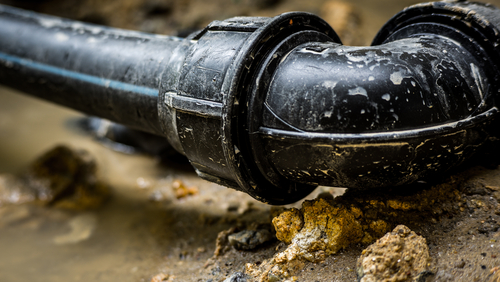
Homes built in Glendale between the 1920s and 1960s typically have sewer laterals made from one of three materials: vitrified clay tile, Orangeburg (bituminized fiber pipe), or early cast iron.
Clay tile was the standard for decades. It performs well structurally but has joints every few feet that eventually separate, allowing roots to enter and soil to infiltrate. Orangeburg was a cheaper alternative used heavily through the 1950s and 1960s. It was literally made from compressed wood fibers sealed with tar. After 50 to 60 years, Orangeburg becomes soft, deforms under soil pressure, and collapses – sometimes completely. Cast iron laterals hold up better structurally but corrode internally, eventually developing holes and heavy scale buildup.
None of these materials last forever. If yours has never been replaced, it is reaching or past the end of its expected service life.
Warning Signs Glendale Homeowners Should Not Ignore
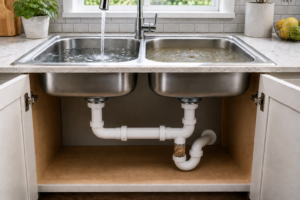
The first sign is usually intermittent slow drains. Not one fixture – all of them. When multiple drains in different parts of the house slow down at the same time, the problem is in the main sewer lateral, not at individual fixtures.
Other signs include a toilet that bubbles when you run the bathroom sink, sewage odor in the yard near the cleanout, wet or unusually green patches of grass along the path of the sewer line, and repeated drain backups that come back within weeks of being snaked.
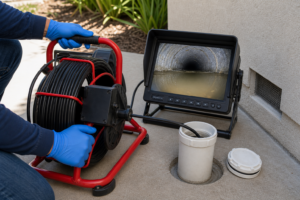
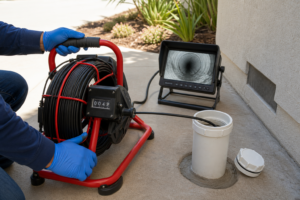
If you have noticed any combination of these in your Glendale home, a sewer camera inspection is the only way to see what is actually happening underground.
Repair Options That Make Sense for Glendale Properties
Not every failing sewer line needs full replacement. The camera footage determines the approach:
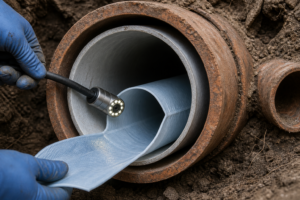
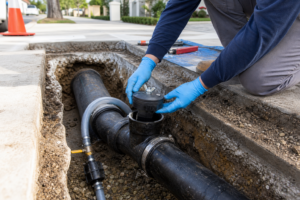
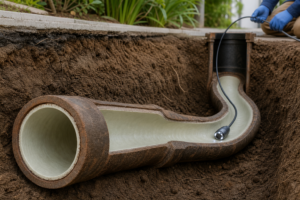
If the pipe is intact but obstructed by roots or buildup, hydrojetting can restore full flow. If roots have entered through separated joints but the pipe has not collapsed, trenchless pipelining seals the joints and creates a smooth interior surface without excavation. If sections have collapsed or the pipe has lost structural integrity, pipe bursting pulls a new HDPE pipe through the old one, destroying the failed pipe and replacing it simultaneously. If the line runs under a city street or sidewalk and the damage is severe, street excavation sewer repair may be necessary – this requires permitting through the City of Glendale.
Each method has a different cost, timeline, and application. The right choice depends entirely on what the camera shows.
Why Glendale Homeowners Should Act Before the Emergency
A sewer lateral that is partially failing will function just well enough to make you think the problem is manageable. You will snake it, it will work for a while, and you will move on. Then one day – usually the worst possible day – it fails completely.
A full sewer backup sends raw sewage into your home through the lowest drain. Cleanup, remediation, and emergency repair during a backup costs two to three times what a planned repair would have cost. The EPA recommends regular inspection and maintenance of residential wastewater systems specifically to avoid these failures.
At Coast to Coast Plumbing and Rooter, we have been repairing and replacing sewer lines across Glendale, Burbank, and Los Angeles since 2008. Our founder Melkon Shameyan built this company around honest diagnostics and fair pricing – and that starts with showing you the camera footage before recommending any work.
Call 310-275-5800 to schedule a sewer camera inspection at your Glendale home. Know what you are dealing with before it becomes an emergency.